New Kensington
One project · map, twin, headsetOne project in two forms. It started as a map of the place I live, and the map is what made the drivable version possible.
nk15068, the map
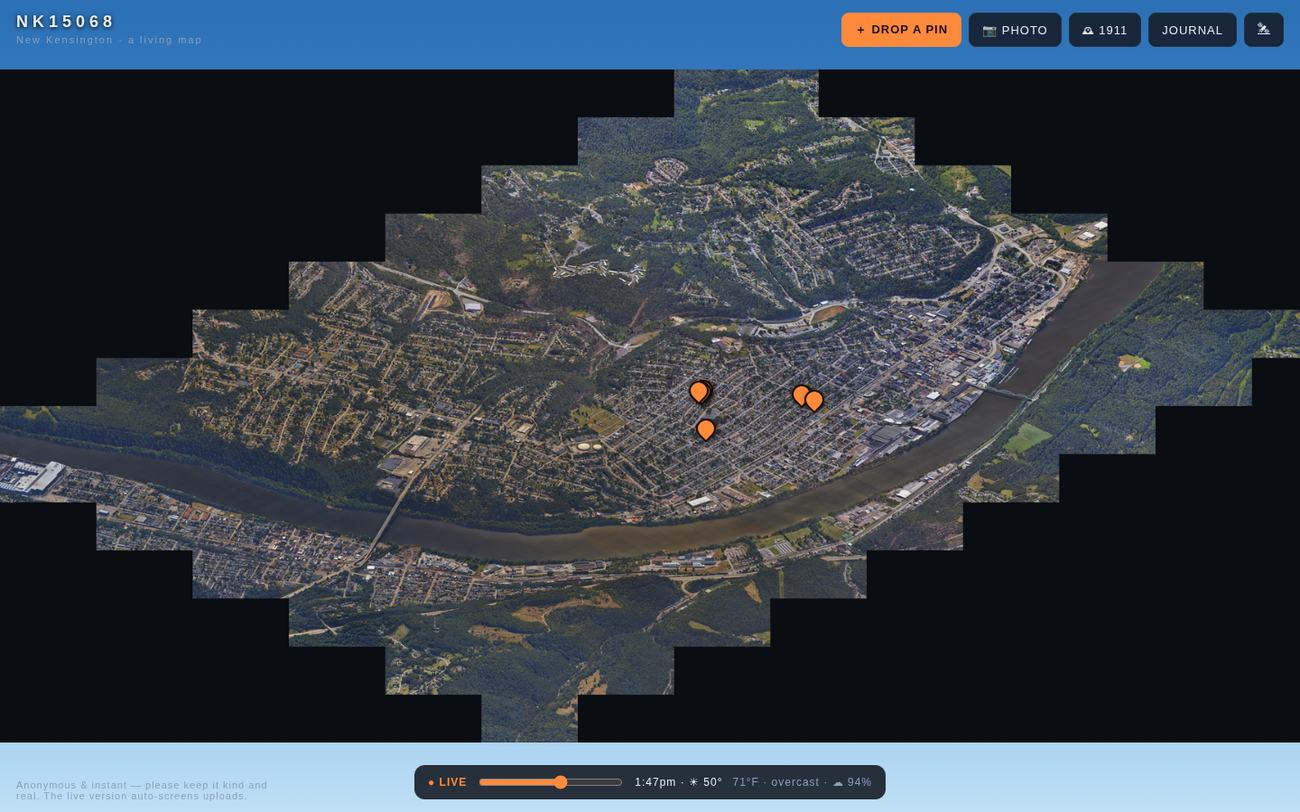
A living map of New Kensington built on real aerial 3D of the whole valley. Anyone can drop a pin and tell its story, add a photo, or lay a 1911 map over the present one to see what stood where. A bar along the bottom tracks the time of day and the actual weather. Businesses get a pin. The plan is sponsored pins, storefront scans and a local newsletter.
NK City, the twin
Working in real aerial data is what led here: the same city rebuilt in Unreal Engine as a place you can drive. Real streets, real houses, the stop signs where they actually are. It began as a teaching tool. Put someone in a place they already know and the only unfamiliar thing in the room is the headset. It now runs on Apple Vision Pro. It improves every pass, and the aim is a model that updates itself instead of one rebuilt by hand.
The same model is what a utility crew, a campus, or a planning office wants: water, gas and electric lines, routes, and buildings you can walk through before anyone digs.
How it got built
-
Problem
A map you look at is not a place you can stand in
Aerial photos and street views flatten a town. Teaching spatial technology needs a place people already know, and planning anything physical needs a version you can move through.
-
Experiment
Aerial 3D, scanning, and a game engine
The map came first. Then 3D capture of individual buildings, then rebuilding the street network in Unreal Engine to find out what it actually takes to make a real town drivable.
-
System
One city, two front doors
The same place feeds a web map anyone can open and a drivable twin that runs in a headset. Streets, buildings and signage stay tied to where they really are, so both improve together instead of drifting apart.
-
Proof
New Kensington, running
The map is live and taking pins from residents. The twin runs on Apple Vision Pro. People who live here recognize their own streets, which is the only test a digital twin has to pass.
AI-assisted development
I use AI agents throughout the build: research, code generation, testing, documentation, and the repetitive production work that would otherwise eat the schedule. Architecture, requirements, validation and the final call stay mine. Generated work that fails validation gets revised or thrown out.